
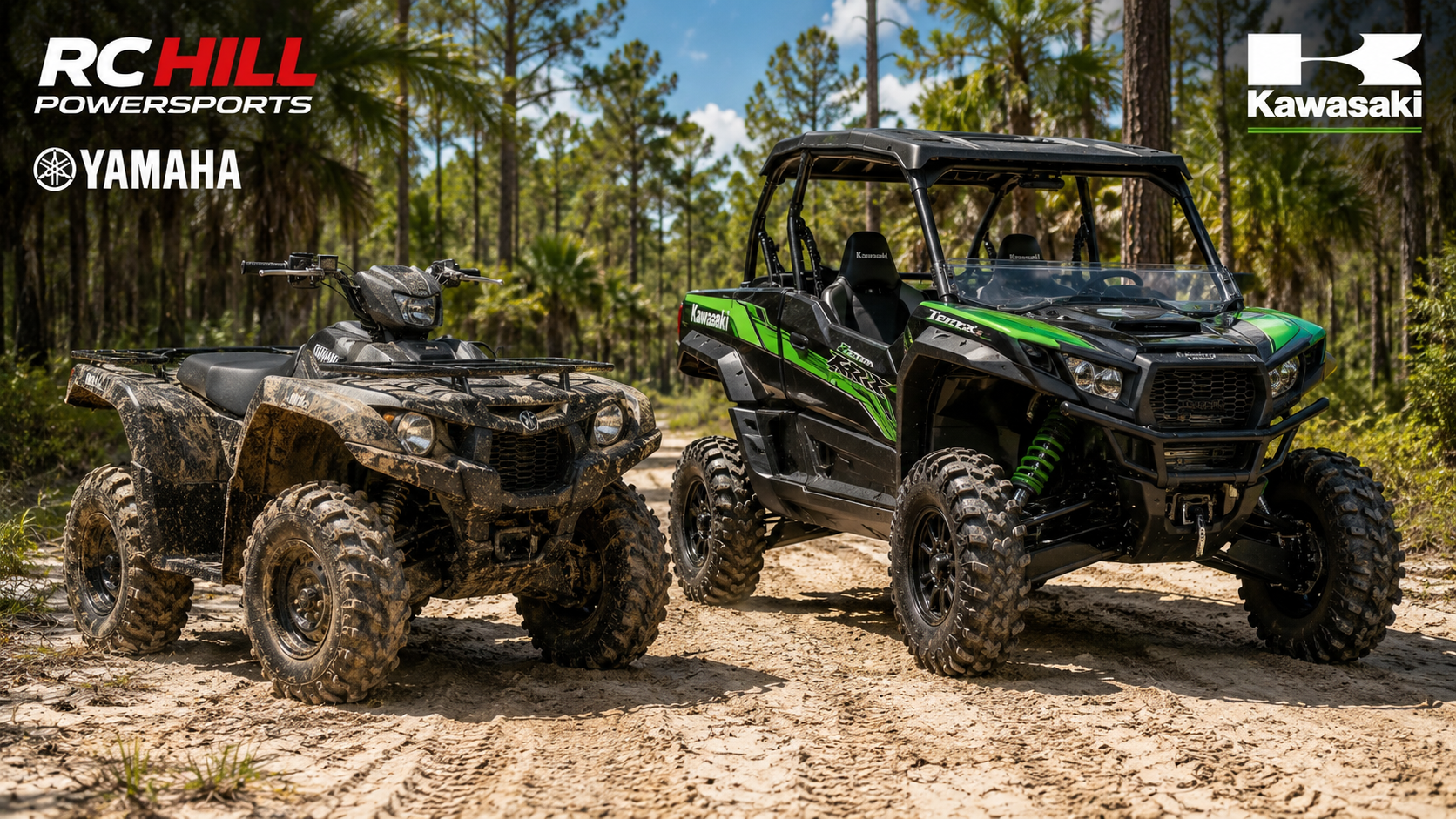
ATV vs. Side-by-Side (SxS) in Orlando
Posted at Tue, Jul 28, 2026 11:12 PM
Selecting the ideal off-road vehicle for Central Florida’s demanding terrain requires a clear look at how engineering, chassis dimensions, and cargo configurations alter your trail experience. At RC Hill Powersports Orlando, we feature a premier inventory of new and pre-owned ATVs and Side-by-Sides (SxS/UTV) tailored for high-speed sport riding, thick mud running, or heavy utility tasks. Our factory-certified mechanics support your machine with extensive multi-point safety checkups so that your vehicle runs efficiently over every mile of sand, clay, or dirt. For immediate inventory updates or to schedule a professional trail readiness check, contact our specialists at (407) 273-3579.
Off-Road Performance & Florida Climate Wear Analysis
Conquering the dusty trails and muddy bogs of Central Florida places immense mechanical strain on an off-road powertrain. When comparing a traditional single-rider All-Terrain Vehicle (ATV) to a multi-passenger Side-by-Side (SxS or UTV), distinct engineering variations alter how environmental wear impacts the chassis over time.
Climate Wear Comparison Matrix
| Off-Road System / Component | ATV Series Trail Impact | SxS / UTV Series Trail Impact | Preventive Maintenance Action |
| Chassis & Exterior Bodywork | Highly exposed seating, handlebar controls, and instruments; fast UV fading and brittle plastics | Partially sheltered interior space; roll-cage structure vulnerable to paint oxidation and rust | Apply specialized UV-blocking protective coatings; park in covered storage bays |
| Electrical Infrastructure | Compact wiring architecture; handlebar controls vulnerable to direct rain intrusion | Intricate electrical layout; extensive wiring harnesses supporting custom lights or winches | Pack electrical couplers with dielectric grease; maintain clean battery terminals |
| Cooling Loop Architecture | Tight, low-profile radiators positioned forward; highly prone to dense mud clogging | High-capacity cooling circuits; large radiators matched with heavy-duty electric fans | Flush out mud deposits from radiator fins post-ride; check coolant chemical levels |
Engineering Breakdown of Florida Climate Wear
Single-rider ATVs offer incredible, compact agility on tight technical trails, but their open cockpit design leaves handle controls, instrument displays, and vinyl seating completely exposed to intense solar rays. When tracking through dusty or muddy environments like the Croom Motorcycle Area, the low-profile radiators positioned at the front of an ATV quickly become choked with debris, trapping engine heat and accelerating oil degradation if not immediately flushed out with clean water.
Conversely, Side-by-Sides rely on larger automotive-style powertrains and intricate, expansive Controller Area Network (CAN bus) wiring paths configured to handle high-amp accessories. Central Florida's persistent relative humidity, which regularly climbs above 80%, allows condensation to settle inside these complex electrical junctions. Without routine application of premium dielectric insulating grease during scheduled multi-point checks, minor moisture intrusion causes rapid pin oxidation and intermittent sensor faults.
Diagnostic Baseline Tracking and High-Mileage Capacity
Accurately measuring the wear profile of an off-road vehicle means assessing total engine run hours alongside odometer totals. Our factory-trained powersports technicians use proprietary diagnostic systems to review computerized fault codes, inspect internal clutch tolerances, and verify compression limits.
For a traditional utility or sport ATV, logging more than 5,000 miles or 500 engine hours generally signals that the vehicle has entered a high-mileage operating tier. By contrast, because they feature larger liquid-cooled powerplants and heavy-duty continuously variable transmissions (CVTs), modern Side-by-Sides can comfortably surpass 10,000 miles or 1,000 engine hours when supported by an uncompromised schedule of professional service.
Our multi-point diagnostic checks prioritize:
-
Cylinder Compression: Checking that internal engine compression tracks tightly within manufacturer PSI design specifications.
-
CVT Belt and Clutch Alignment: Gauging drive belt wear width, checking for high-heat hairline cracking, and verifying proper drive pulley sheave orientation.
-
Suspension Bushings and Bearings: Inspecting for play across steering A-arms, wheel bearings, and shock absorber mounts, all of which face severe stress on Florida's sandy trail tracks.
Value Retention Metrics & Ownership Lifespan Scales
Off-road vehicle value retention in the pre-owned market is determined by manufacturer build quality, component availability, and verified service records. Industry-leading brands like Yamaha and Kawasaki command an absolute premium at trade-in time because their rugged engine architectures are built for long-term survival.
When evaluating your long-term investment, vehicle class plays a massive role in equity curves. Utility ATVs generally face fewer electrical accessories and lower overall strain, yielding a highly predictable, linear depreciation schedule. Conversely, High-Performance SxS models experience substantial mechanical demands due to high-RPM forced induction layouts and aggressive trail usage. This makes keeping a clean, documented history of factory maintenance checks your single most effective tool for protecting your equity, proving clutch health, and maximizing trade-in value when upgrading your machine.
Estimated Value Retention & Lifespan Scale
| Off-Road Vehicle Class | Average Lifespan (Years) | 3-Year Value Retention (%) | 5-Year Value Retention (%) | Primary Source of Market Depreciation |
| Yamaha Utility ATVs (e.g., Grizzly, Kodiak) | 12 - 15 Years | 75% | 60% | Exterior aesthetic abuse, suspension component neglect |
| Kawasaki Sport Utility SxS (e.g., Teryx, Mule) | 10 - 14 Years | 70% | 55% | CVT clutch neglect, frame stress from extreme hauling |
| High-Performance SxS (e.g., Yamaha YXZ Series) | 8 - 12 Years | 65% | 48% | Extended high-RPM operation, severe drive belt abuse |
Regional Logistics and Pickup Infrastructure
Hauling a non-running Side-by-Side or an unrideable ATV through busy Orlando traffic can be a massive challenge if you don't own heavy-duty commercial trailers. To make keeping up with your 50-hour service checks fluid and hassle-free, RC Hill Powersports Orlando provides professional vehicle transport and flatbed pickup options within a 15-mile primary radius of our dealership.
Our transport infrastructure balances service routing based on the dominant off-road style of each area:
-
Sport Trail Units: Quick transit lines for nimble sport ATVs and agile trail machines popular with riders in the East Orlando & UCF Area.
-
Heavy Utility Fleets: Secure, flatbed hauling optimized for high-capacity utility vehicles (such as the Kawasaki Mule) deployed across Kissimmee & St. Cloud.
-
Recreational Family SxS Transit: Scheduled trailer transport loops tailored for family recreation vehicles coming out of Sanford & Lake Mary.
Technical Troubleshooting and Inquiries
-
Q: Why is my ATV or SxS engine losing power under heavy acceleration?
-
A: Fuel system restriction or a worn CVT belt is typically the primary cause. Technicians inspect the fuel pump pressure, clean clogged fuel injectors, and measure the CVT belt width to ensure proper clutch engagement.
-
-
Q: How often should I change the oil on my off-road vehicle in Florida?
-
A: Every 50 hours of operation or 6 months is the recommended interval for vehicles operating in hot, dusty, or sandy Florida environments. Frequent oil changes prevent abrasive sand particles from scoring engine cylinders.
-
-
Q: What causes squeaking noises from the suspension when riding over bumps?
-
A: Dry or worn suspension bushings are the most common culprit. Applying marine-grade grease to the grease zerks on the A-arms and sway bars usually resolves the noise; otherwise, bushing replacement is required.
-
-
Q: Can I ride my ATV or SxS on public paved roads in Orlando?
-
A: No, Florida law prohibits operating non-street-legal ATVs or UTVs on public roads unless specifically designated by local county ordinances.
-
-
Q: Why is my 4WD system failing to engage on the trail?
-
A: Electrical actuator failure or damaged vacuum lines typically prevents the front differential from locking. We run diagnostic scans on the electronic 4WD switch and inspect the actuator harness for physical damage.
-
Route Mapping and Showroom Access
Our flagship showroom sits at 9334 East Colonial Drive, Orlando, FL 32817, providing streamlined access from every major Central Florida corridor
-
From the North (Sanford/Lake Mary): Take the Central Florida GreeneWay (SR 417) South, exit onto East Colonial Drive East, and proceed less than half a mile. Our showroom will be on your right.
-
From the Downtown Orlando: Travel East on SR 50 (East Colonial Drive) approximately 12 to 15 minutes past the Executive Airport and Dean Road. We are located on the right, just before SR 417.
-
From the South (Kissimmee): Take SR 417 North to East Colonial Drive East, and turn into our entrance on the right.
Verified RC Hill Powersports Orlando Hours and Address
Connect with our sales team, source genuine OEM replacement parts, or drop off your vehicle for a comprehensive mechanical inspection by visiting our storefront.
-
Phone Number: (407) 273-3579
Operating Hours
| Day | Showroom Hours | Service & Parts Hours |
| Monday | Closed | Closed |
| Tuesday | 9:00 AM - 6:00 PM | 9:00 AM - 6:00 PM |
| Wednesday | 9:00 AM - 6:00 PM | 9:00 AM - 6:00 PM |
| Thursday | 9:00 AM - 6:00 PM | 9:00 AM - 6:00 PM |
| Friday | 9:00 AM - 6:00 PM | 9:00 AM - 6:00 PM |
| Saturday | 9:00 AM - 6:00 PM | 9:00 AM - 6:00 PM |
| Sunday | Closed | Closed |
The Bottom Line: Why Factory Care Matters
From an engineering standpoint, choosing between an ATV and a Side-by-Side comes down to your specific operational envelope. ATVs offer unmatched agility in tight, technical wooded trails, whereas Side-by-Sides provide superior stability, payload capacity, and passenger safety via integrated roll-over protective structures (ROPS). At RC Hill Powersports Orlando, we ensure every vehicle—whether a sport ATV or a commercial-grade UTV—undergoes a rigorous multi-point inspection so that our riders experience maximum reliability on Florida's demanding terrains.